
WorldCorner: Evaluating Driving World Models for Safety-Critical Event Generation
*Equal contribution †Corresponding author
Driving world models promise scalable synthesis of corner cases that are rare but critical for autonomous vehicle deployment. However, the ability to generate corner cases does not guarantee their quality, and existing evaluations of these models largely focus on normal driving scenarios. We introduce WorldCorner, a benchmark for evaluating driving world models on safety-critical event generation. We first build CornerScenes, a dataset of more than 1,200 safety-critical scenarios adapted from nuScenes, each paired with its original normal scene. Four complementary dimensions are then designed to evaluate the generated videos: generation quality, controllability, critical event realization, and ADS functional utility, complemented by a human study. Benchmarking results indicate broad performance degradation on corner cases and a tendency to fall back on normal-driving priors, and show that conventional quality metrics cannot capture the faithful generation of the intended safety-critical event. WorldCorner establishes a foundation for evaluating corner case generation in world models, and shifts the target from perceptual realism toward safety-oriented fidelity for physical AI systems.
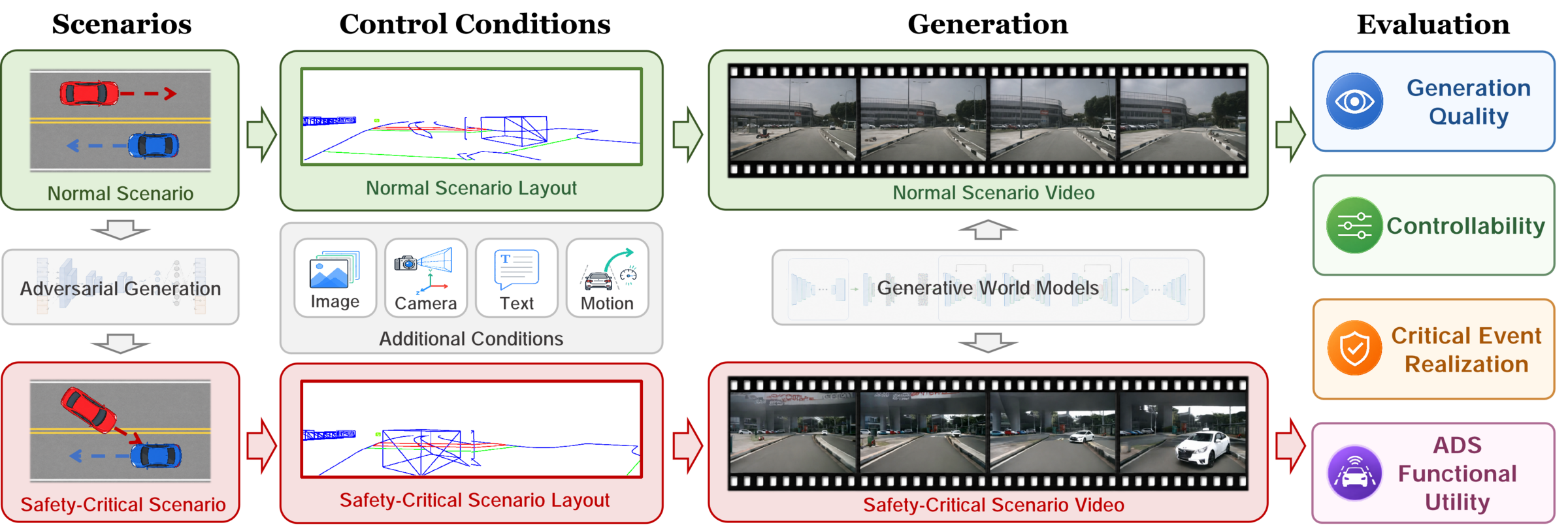
Overview of the WorldCorner benchmark pipeline. Behaviors in normal nuScenes scenarios are modified via adversarial generation to construct the safety-critical scenarios in CornerScenes. Control conditions are then extracted — in particular the HD map and the 3D control boxes of the surrounding traffic — which specify the scenario layout and encode the safety-critical interaction. These conditions drive video generation, and the resulting videos are evaluated across four dimensions comprising 12 metrics in total.

A large-scale corner-case dataset
CornerScenes turns real nuScenes scenes into safety-critical corner cases: CTG++ modifies only the trajectories of a selected high-risk vehicle pair — under two adversarial roles, Other-as-Attacker and Ego-as-Attacker — while the road structure, background traffic, and environment context remain untouched. Each corner case is paired with its original normal scene.
| Split | Adversarial Mode | Entries | Avg. Frames | Avg. Agents | Event Type Distribution | ||
|---|---|---|---|---|---|---|---|
| FRONT | SIDE | REAR | |||||
| train | Other-as-Attacker | 526 | 60.2 | 48.8 | 99 | 91 | 336 |
| train | Ego-as-Attacker | 572 | 61.0 | 50.2 | 216 | 183 | 173 |
| val | Other-as-Attacker | 76 | 59.3 | 36.9 | 6 | 21 | 49 |
| val | Ego-as-Attacker | 97 | 62.7 | 42.4 | 71 | 25 | 1 |
CornerScenes statistics. The validation split (173 scenes, unseen by all benchmarked models) is used for evaluation; the training-split scenes are released to support future work.
The first two dimensions test whether performance degrades under safety-critical conditions; the latter two examine event-level fidelity and downstream utility. Metrics are reported separately rather than aggregated, as they capture distinct and non-monotonically related capabilities.
Are the generated scenes visually authentic, temporally cohesive, and semantically sound?
Does the generated video follow the full scene-layout control conditions?
Is the intended safety-critical event itself faithfully reproduced over time?
Can an end-to-end ADS correctly interpret the safety-relevant content and react?
We evaluate seven representative driving world models, all trained on nuScenes and sharing similar structured control conditions for a fair comparison:
All values are averaged over four random seeds on the CornerScenes evaluation split. Other as Attacker: another vehicle approaches the ego vehicle; Ego as Attacker: the ego vehicle approaches another vehicle. The I-shaped marker shows each model's score on the paired normal driving scenes, where available.
Representative failure modes on CornerScenes.
Each pair is one control condition rendered by two models. To see all seven models at once on these and further cases, open the Model Comparison page.
@misc{worldcorner2026,
  title  = {WorldCorner: Evaluating Driving World Models for Safety-Critical Event Generation},
  author = {Wang, Jiawei and Bi, Bodong and Luo, Kaiyang and Song, Xujie and Hua, Shaowei and Sun, Haowei and Gao, Jun and Liu, Henry X.},
  year   = {2026},
  note   = {Under review}
}